AI Economics
The Economics of Enterprise AI
Enterprise AI becomes valuable when technical possibility is translated into economic choices, operating constraints, and measurable outcomes.
Insight
7 min
In April 2026, only four months into the year, Uber had already exhausted its annual budget for AI coding tools. Claude Code had spread across roughly 5,000 engineers faster than the company’s financial assumptions anticipated. Uber’s CTO, Praveen Neppalli Naga, said the company was “back to the drawing board.” The absolute dollar value of the budget was not disclosed, so this should be described as a confirmed budget overrun, not as a quantified corporate loss. But the economic signal is difficult to miss: adoption succeeded faster than the operating model could control it. [1]
What makes the case particularly instructive is what happened next. Uber did not simply restrict access or negotiate a lower price. It improved prompt caching, changed default model choices, evaluated alternative models for efficiency, and gave engineers visibility into their AI usage and hourly costs. According to Naga, the number of employees using frontier AI tools subsequently quadrupled while cost per token declined. His explanation was telling: Uber treated efficiency “as an engineering problem rather than a budget problem.” [2]
That is the central lesson of enterprise AI economics. AI cost is not determined only when procurement negotiates a contract. It is determined continuously by architecture, software behavior, user incentives, and operating controls.
The bill is created inside the architecture
A conventional software license is reasonably predictable: price per seat multiplied by seats. AI consumption is different. A user request may include system instructions, retrieved documents, conversation history, tool definitions, generated output, internal reasoning, retries, and multiple agent or tool calls.
The visible response is therefore a poor proxy for what was consumed. OpenAI’s documentation, for example, distinguishes input, cached-input, output, and reasoning tokens. Reasoning tokens are not visible to the user but count toward output usage and are billed as output tokens. Tools, files, images, schemas, and message structure can also change a request’s total token count. [3]
An agent makes this variability more pronounced. One business task can become a chain of planning calls, retrievals, tool executions, validation steps, corrections, and retries. The user sees one outcome; the enterprise pays for every intermediate step.
A useful economic denominator is therefore not cost per token. It is:
Cost per successful outcome = total model, routing, retrieval, tool, retry, infrastructure, and evaluation cost ÷ accepted business outcomes
Tokens remain important because they expose where consumption originates. But they are an intermediate accounting unit, not the business result. The Linux Foundation’s Tokenomics Foundation now makes essentially this distinction: it defines AI economics across production, consumption, and value, and proposes cost-to-serve and value measures that extend beyond raw token counts. [4]
Cheap tokens do not guarantee cheap AI
Falling model prices can create false confidence. If a task begins using a larger context window, more reasoning, additional tools, or an agent that retries autonomously, total task cost can rise even while the advertised price per million tokens falls.
OpenAI’s public admission about ChatGPT Pro illustrates the pricing risk. CEO Sam Altman said that the $200-per-month plan was losing money because customers used it more than expected. The company did not disclose the magnitude of the loss, but the statement demonstrates that even a premium flat price can be overwhelmed by unanticipated inference intensity. [5]
Model choice is equally consequential. Using the most capable model for every task may feel prudent during a pilot, but becomes an expensive default at scale. AWS states that its Bedrock Intelligent Prompt Routing can route requests between models according to predicted quality and cost, reducing cost by up to 30% without compromising accuracy in its evaluated configurations. [6] The broader principle is more important than the vendor figure: model selection should be a runtime economic decision, not a design-time constant.
Caching provides another example of architecture becoming economics. OpenAI documents cached-input discounts of up to 95% where requests reuse eligible prompt prefixes. It also provides cache-hit telemetry because simply enabling a cache does not guarantee that application structure will produce hits. [7] Anthropic similarly differentiates ordinary input, cache writes, and cache reads, with cache hits priced at a fraction of normal input cost. Its documentation warns that changing tool definitions, instructions, reasoning settings, or content ordering can invalidate the cache. [8]
In other words, two applications can use the same model, process the same apparent workload, and have materially different economics because one preserves reusable context and the other repeatedly recomputes it.
Governance is also an economic control
Governance is sometimes treated as a compliance layer that slows delivery. In enterprise AI, well-designed governance is also protection against economic leakage.
A small but authoritative example is Moffatt v. Air Canada. Air Canada’s website chatbot gave incorrect information about claiming a bereavement fare. The British Columbia Civil Resolution Tribunal found that the airline had not taken reasonable care to ensure the chatbot was accurate and ordered it to pay C$812.02 in damages, interest, and fees. The amount was not material to Air Canada, and the public record does not establish that the system used a generative LLM. The case is useful for a narrower reason: the tribunal held the company responsible for information produced by its deployed automated system. [9]
At enterprise scale, the economic exposure is not only the model bill. It includes incorrect decisions, customer remediation, compliance work, operational recovery, reputation, and human review. A cheaper workflow that generates more unusable or risky outcomes can be more expensive than a premium model that succeeds reliably.
This is why evaluation and governance belong inside the economic control loop rather than beside it. The objective is not minimum spend. It is the lowest sustainable cost that meets the required quality, latency, safety, and business-outcome threshold.
The following diagram shows the operating relationship: workload telemetry exposes consumption; the control plane governs routing, context, caching, agent behavior, and budgets; and actual cost is reconciled against successful outcomes. This reflects the workload-level measurement and governance direction documented by the FinOps and Tokenomics communities. [10] [4]
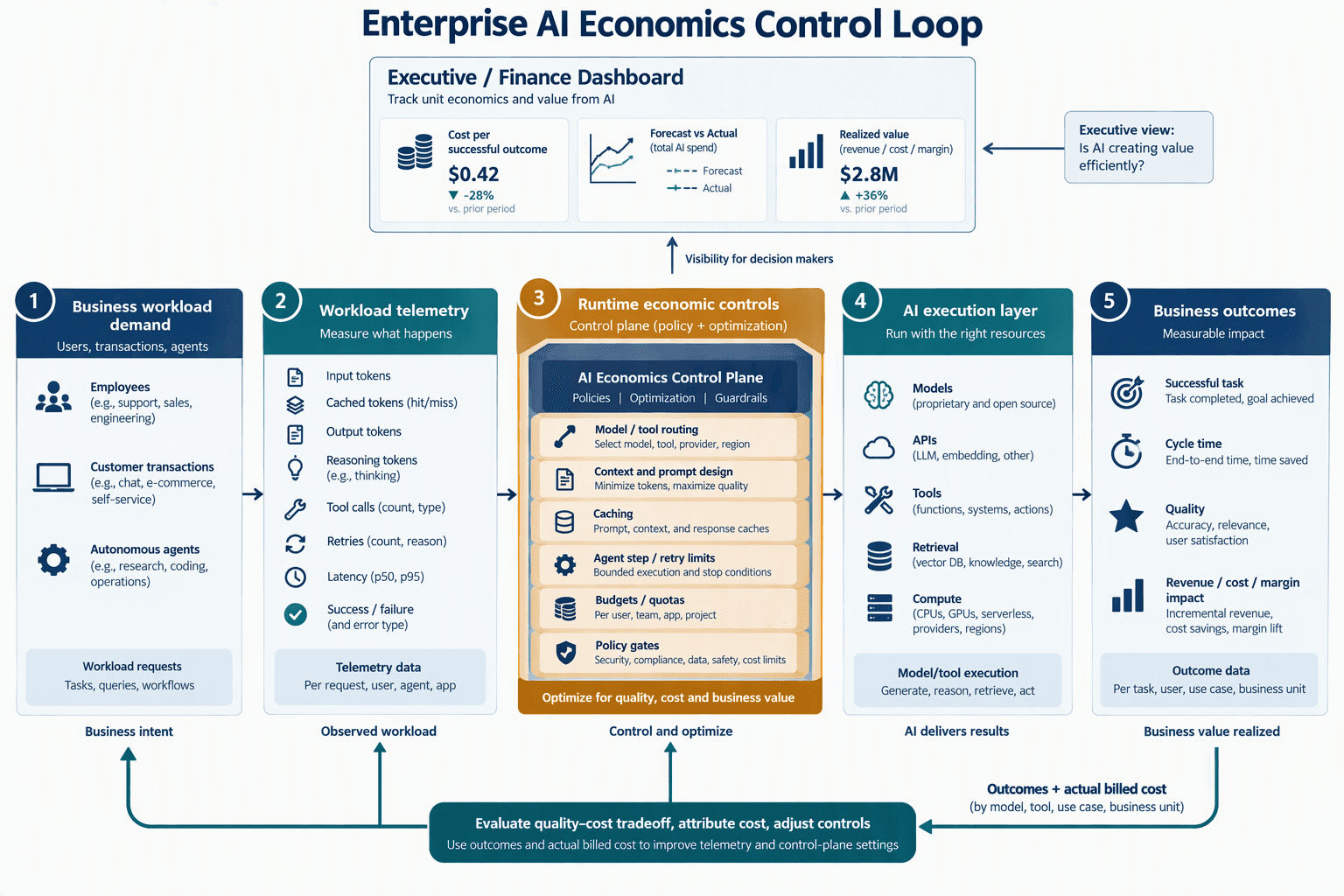
Figure 1: Enterprise AI economics works as a closed-loop control system: meter each workload, govern the architectural levers that drive consumption, and connect actual cost to successful business outcomes.
Why ordinary FinOps is necessary but insufficient
Traditional FinOps provides essential foundations: allocation, forecasting, anomaly detection, rate optimization, commitments, and accountability for variable cloud spend. AI does not replace those disciplines.
It does, however, add a layer that ordinary cloud billing cannot fully explain. Cloud data may show which service or account incurred the cost. It may not show which business workflow initiated the request, which model actually served it, how much context was unnecessary, whether a cache should have hit, how many retries occurred, or whether the task ultimately succeeded.
The FinOps Foundation identifies precisely these differences: inconsistent AI meters, difficult allocation across multi-agent workloads, lower forecastability, more complex quality-versus-cost decisions, and the need to connect usage to business outputs. It recommends quotas, tagging, spend monitoring, anomaly detection, workload baselines, and outcome-oriented unit metrics such as cost per inference. [10]
An effective AI Economics discipline should therefore extend FinOps in six practical ways:
Instrument the workload, not only the invoice. Capture model, input, cached input, output, reasoning, tool usage, retries, agent steps, latency, outcome status, and actual billed cost for each trace.
Make model and tool choice governable at runtime. Route routine work to the cheapest path that satisfies an evaluated quality threshold, and escalate only when the task requires it.
Treat context as a managed economic asset. Measure reusable versus changing context, cache-hit rates, retrieval relevance, conversation growth, and the cost of repeatedly transmitting tool definitions or irrelevant documents.
Bound autonomous consumption. Apply budgets, quotas, maximum steps, retry limits, timeouts, tool permissions, and circuit breakers to agents. An agent should not possess an economically unbounded mandate.
Evaluate quality and cost together. Model comparisons should report cost per accepted or successful task, including failures and retries, rather than token price or benchmark quality in isolation.
Connect technical evidence to the P&L. CFOs and business owners should see cost-to-serve, forecast versus actual, unit margin, realized capacity, revenue contribution, and risk-adjusted outcome. Productivity estimates should remain separate from realized financial value until validated.
The executive decision standard
The relevant question for a CIO or CTO is no longer simply, Which model is best? It is: Which architecture produces the required outcome with acceptable quality, control, and unit economics?
For the CFO, the question is not, How much are we spending on tokens? It is: What does a successful AI-assisted transaction, resolved case, completed engineering task, or protected revenue outcome cost us, and how does that compare with the alternative?
For the board, raw adoption is not evidence of value. Neither token volume, user count, generated code, nor the number of deployed agents proves economic return. Uber’s first phase rewarded consumption; its corrective phase engineered efficiency and visibility. That distinction should shape every enterprise AI investment decision. [2]
The economics of enterprise AI will not be won by purchasing the cheapest tokens. They will be won by organizations that can observe consumption, control architecture, govern autonomy, and prove value at the level of the business outcome.
CONTINUE EXPLORING
More writing on technology, AI economics, systems thinking, leadership, and mentoring.
CONNECT